Two intensive courses, taught from real research experience. Small groups. Real equipment. You leave with something that works.
From empty scene to logged data.
Game engines are the most powerful experimental platform most scientists never use. In four days, you'll build and run your own VR experiment in Unity — interactions, conditions, trials and data logging — and deploy it to a headset. No coding or game-dev background required to start.
From setup to publishable kinematics.
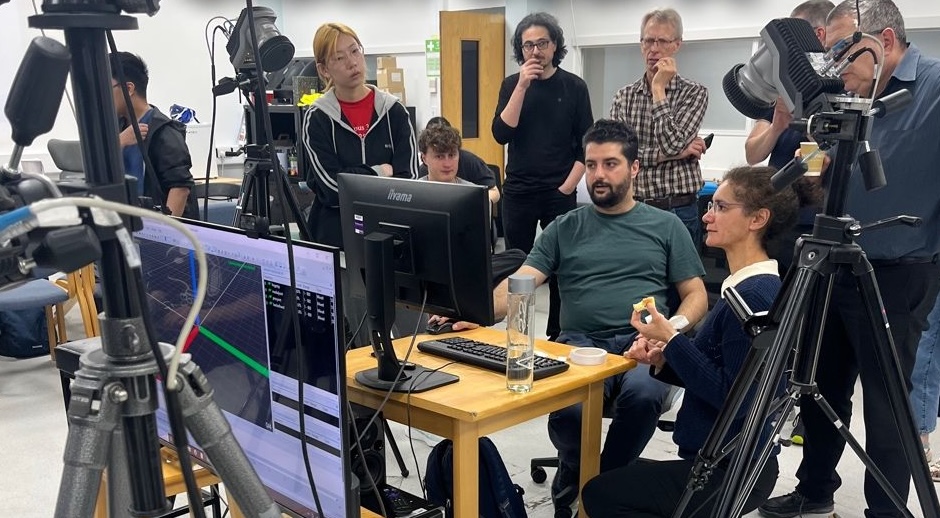
Motion capture done wrong produces beautiful noise. In three days, you'll learn to run a capture session end to end — calibration, clean recordings, troubleshooting — and export kinematics ready for your analysis pipeline. Taught in a working research facility, on the systems used for real studies.
Everything is built around one goal: you go back to your lab able to do this yourself.
Choose a cohort and register your interest. I'll follow up by email with pricing, joining details and confirmation. No payment is taken now — registering holds your spot.
No. Both courses are designed for researchers starting from zero — no coding, game-development or engineering background required. If you already have some experience, you'll simply go deeper.
Pricing is shared by email when you register — it varies with cohort size and institutional arrangements. Registering is free and non-binding, and no payment is taken until your place is confirmed.
Just yourself. All equipment, software and materials are provided. For the game-engine course, you're welcome to bring your own laptop if you'd like to leave with everything installed.
Yes — both courses, plus a one-day 3D Modelling & Printing course, can be delivered to your lab or department. Choose “bespoke” on the form or email me directly.
I do — drawing on a decade of sensorimotor research, building the University of Birmingham's markerless Movement Lab, and shipping hand tracking at Meta. You learn the workflows used in real studies.